
What recent rail-replacement deployments are teaching us about portability, existing vehicle systems and designing technology around real fleets.
Imagine a fleet in which every bus and coach is identical: the same age, same manufacturer, same model and the same onboard equipment.
Deploying passenger information would be simple: one hardware specification, one installation method, repeated across the entire fleet. Straightforward, predictable and easy to support.
But that is not the reality most operators face.
Bus and coach fleets are mixed by nature. Vehicles come from different manufacturers and generations. Some already have screens and audio systems installed; others have no suitable passenger-information equipment at all.
Rail replacement introduces another layer of complexity. Vehicles may need to move between contracts, routes and operating environments at short notice.
That makes rail replacement one of the toughest tests of accessible passenger-information technology. It also makes it one of the clearest opportunities for meaningful innovation across the bus and coach industry.
Start with the vehicle (not the equipment)
At Rise Digital Media, we have spent the past few years developing and deploying NextStop®, our passenger-information platform for bus and coach operators.
Our wider work now extends across more than 400 vehicles and several operating groups. More recently, we have focused on a particular challenge: how to give rail-replacement operators a reliable way to provide audible and visible passenger information without requiring a permanent installation or extensive engineering work on every vehicle.
Rather than forcing a single hardware configuration across the fleet, we have built a flexible operating model around a common cloud platform, consistent journey data and a range of portable deployment options.
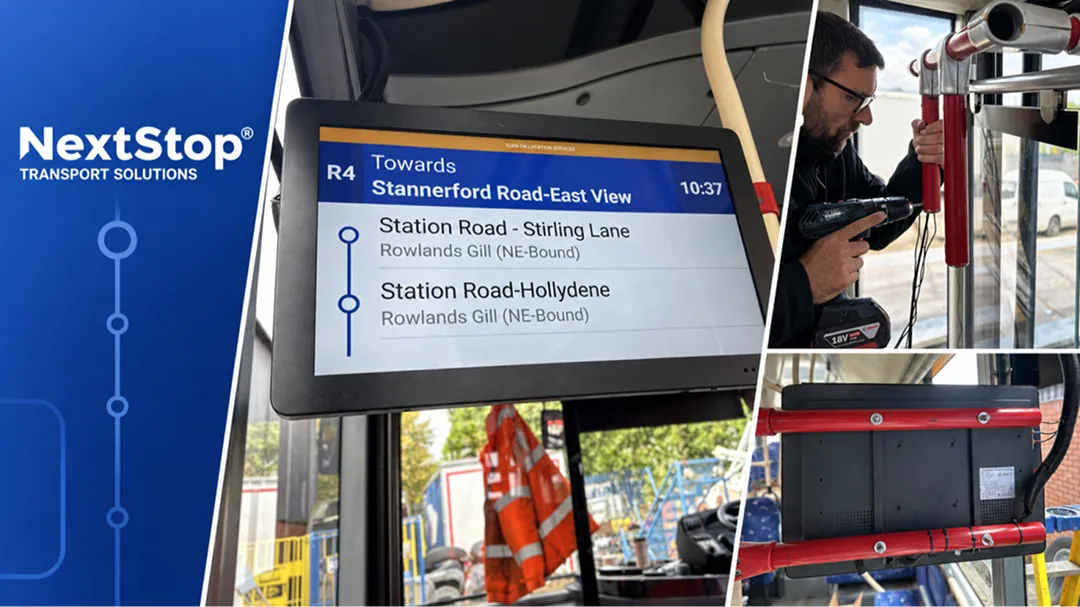
Our starting point is the vehicle itself. We assess what is already available and identify the most appropriate way to deliver passenger information within that particular vehicle. Where suitable passenger displays and audio equipment are already installed, our NextStop® Driver App can connect to and make use of that existing infrastructure. Where a vehicle has suitable grab rails, we can use them to secure a portable screen. Where the window position and vehicle layout allow, we can use a window-mounted solution. Other vehicles may be better suited to a ceiling-mounted installation. Where additional audio provision is required, portable Bluetooth speakers and hearing-loop equipment can be incorporated into the solution.
The principle is straightforward: retain and reuse suitable equipment wherever possible, then add only what the vehicle needs. Operators should not need separate passenger-information systems for buses and coaches simply because the vehicles are materially different. One platform should manage accessible information consistently across the fleet, while the physical deployment should be adapted to each vehicle, whether that involves a portable screen, additional audio equipment or integration with existing onboard systems.
This gives operators one underlying platform and passengers one consistent experience, without forcing every vehicle into the same hardware configuration.
Put simply, the technology needs to adapt to the fleet—not force the fleet to adapt to the technology.
Re-use before replacing - connecting the NextStop Driver App to the coach's existing AV system
Proving the model in live operations
This approach has now been tested through the deployment of 28 portable rail-replacement passenger-information kits across three operators in the South East and South West of England. The deployments cover mixed fleets of service buses and coaches, with different vehicle types, existing equipment and operational requirements.
Vehicles without suitable onboard equipment have been provided with portable passenger-information screens using window, grab-rail or ceiling-mounted solutions, depending on the layout and suitability of each vehicle.
These installations can be supported by portable audio and hearing-loop provision, giving operators a complete solution that can move between suitable vehicles as contracts and fleet allocations change. Where coaches already have passenger displays and audio systems, we have taken a different approach.
The NextStop® Driver App sits securely in a powered docking cradle and connects to the vehicle’s audiovisual system through a standard USB-C-to-HDMI interface. Once paired with the vehicle, the app receives trip information from the NextStop® cloud platform and delivers it through the coach’s existing passenger displays and audio system.
The programme has also included our first direct integration with the Bosch Coach SmartPanel multimedia system, deployed on both Volvo MCV eVoTor and Volvo 9700 coaches. This hybrid approach minimises additional hardware, avoids unnecessary vehicle modifications and makes full use of equipment already installed onboard.
These deployments demonstrate that one passenger-information platform can support very different fleets and operating environments without imposing one hardware configuration on every vehicle.
Consistent data, however the journey is selected
The same adaptable principle applies to journey data. Where integration with an electronic ticket machine is available, journey information can be supplied to NextStop® through the ETM. Where there is no suitable ETM integration, the NextStop® Driver App gives the driver a straightforward way to select and manage the assigned journey. The method may change, but the data foundation does not.
Both approaches use a consistent data format, standards-compliant route information and recognised national datasets for stop names and locations. This allows operators to choose the most appropriate equipment and workflow for each vehicle without creating separate passenger-information systems across the fleet.
Better data through industry collaboration
Making this flexible model work depends on reliable, consistent data. That data foundation is beginning to improve. No single technology provider can solve this challenge in isolation. We are working with operators, audiovisual manufacturers, accessibility specialists and other industry partners to expand what NextStop® can deliver and make deployment simpler across different vehicles and operating models.
We have also been encouraged by recent progress at national level. The Department for Transport has introduced a dedicated Rail Replacement Location dataset, made available through the National Public Transport Access Nodes (NaPTAN) service.
Supplied by the Rail Delivery Group, the dataset identifies passenger pick-up and drop-off locations used for planned rail-replacement services across England, Scotland and Wales. This gives operators and technology providers a more consistent starting point. It means we can begin pre-loading recognised rail-replacement locations into NextStop®, reducing manual setup and creating a stronger foundation for onboard displays and audible announcements.
The dataset is currently being provided as a pilot, and there is still work to do. Its long-term value will depend on the accuracy, completeness and continuing stewardship of the information supplied by the relevant data owners.
It is also important to understand the role of the national dataset. It tells us where a rail-replacement vehicle may collect or set down passengers. It does not provide the complete route, timetable, vehicle assignment or real-time operational information required to deliver a particular journey.
That is where operators, delivery partners and technology platforms add the operational context. Alongside the national location data, we are exploring API-based data exchanges that could bring planned route information, ordered stopping sequences, stop identifiers and location coordinates directly into the NextStop® cloud platform.
The objective is to allow route information to flow directly from operational planning systems into the NextStop® cloud platform, rather than requiring the same journey to be recreated manually in multiple systems. This work remains at an early stage. It does not yet represent a live integration, and the data will still require validation and additional operational information such as schedules, vehicle assignments and service updates. However, it points towards a more integrated approach.
By combining authoritative national stopping locations with operational route information, operator schedules and vehicle assignments, we can create a clearer data flow from service planning through to the visual information and audible announcements delivered onboard the vehicle. This is the kind of industry collaboration we need: common data foundations at national level, operational information from delivery partners and adaptable technology capable of turning that information into a better passenger experience.
Five lessons from live deployment
Our recent work has reinforced five principles that I believe should shape the next generation of passenger-information systems.
Standardise the platform, not the hardware
A mixed fleet will never become completely uniform. Operators need one consistent platform for journey data, content and operational control, with the flexibility to deliver passenger information through different types of onboard equipment.
Reuse before replacing
Many vehicles, particularly coaches, already have capable displays, amplifiers and speaker systems. Where that equipment is suitable, replacing it creates unnecessary cost, engineering work and electronic waste. Existing vehicle technology should be treated as an asset.
Make portability an operational advantage
Portable equipment should not be regarded as a compromise. A properly designed portable system can be assigned to the vehicles required for a contract, moved as fleet requirements change and deployed without taking vehicles out of service for extensive engineering work.
Keep day-to-day operation simple
A passenger-information system should not create unnecessary complexity for the driver or depot team. The workflow must be straightforward: identify or pair the vehicle, select the assigned journey and allow the platform to manage the passenger information.
Treat installation as the beginning
Equipment alone does not deliver accessible passenger information. Successful operation also depends on accurate data, central content management, staff training, monitoring and clear operational ownership. Installing a kit is only the beginning. The real objective is to deliver accurate audible and visible information reliably, journey after journey.
Continuing the conversation at Euro Bus Expo
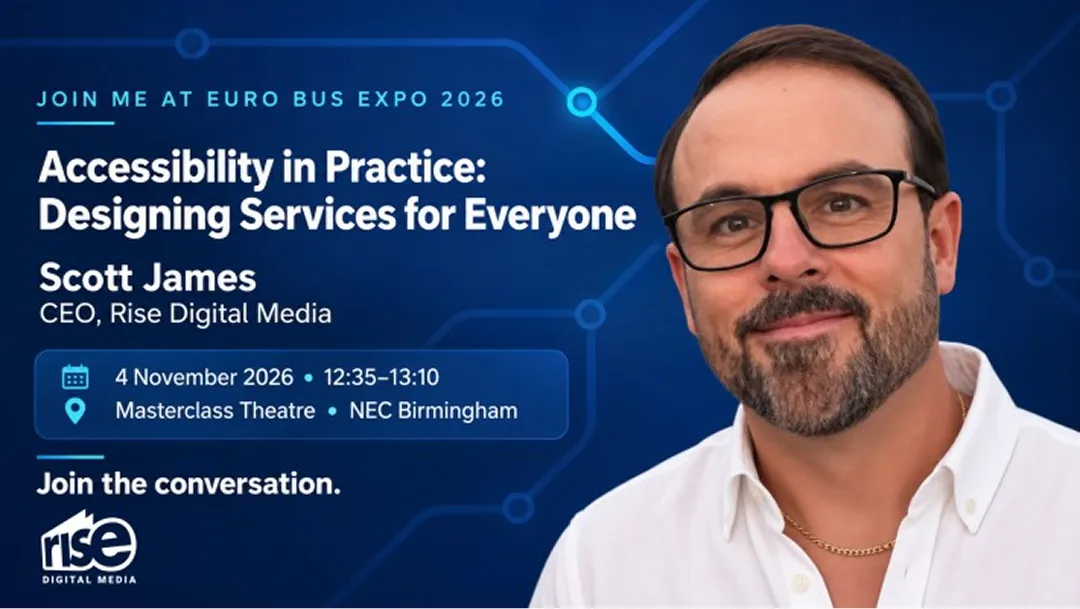
I will be discussing these challenges at Euro Bus Expo at the NEC Birmingham this November as part of the session “Accessibility in Practice: Designing Services for Everyone.”
The session will explore how inclusive vehicle design and flexible technology can help reduce sensory, cognitive and physical barriers while delivering solutions that remain practical and cost-effective for operators.
I’m looking forward to joining Gavin Miller from the Confederation of Passenger Transport and Chris Edwards-Thorne from Altro, as well as continuing the wider industry conversation with accessibility specialists including Ampetronic.
Euro Bus Expo takes place from 3–5 November 2026, with our session in the Masterclass Theatre on Wednesday 4 November from 12:35 to 13:10.
If you operate rail-replacement services, manage a mixed bus and coach fleet or already have screens and audio equipment that could be put to better use, I would be interested to hear about the challenges you are encountering.
Accessible passenger information should not be limited by the age, manufacturer or operating model of the vehicle.
Our job as technology providers is to make it work in the real world.
